


War is a dreadful thing, and I would rather do anything in the world than kill a man or help to kill one—but then if we were to let Lincoln’s army pass here, they might go into the State of Virginia and burn our homes and kill the old men and the women and children, and do a great deal more harm—and I am sure I would rather see a thousand of them killed around me, than to know that they had done any harm to my wife and dear little boys.
Source: Samuel J. C. Moore to “My Dear Little Boy,” May 16, 1861, Southern Historical Collection, University of North Carolina, Chapel Hill.
Also: Historical marker related to Samuel J. C. Moore
Showing posts with label why they fought. Show all posts
Showing posts with label why they fought. Show all posts
Sunday, November 13, 2011

Saturday, February 21, 2009
A General Explains Motives for War
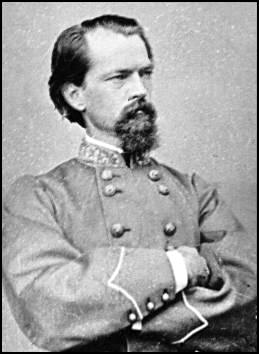
"Reminiscences of the Civil War", by John B. Gordon, Maj. Gen. CSA
Tuesday, January 20, 2009
Civil War Memory
 My grandparents remembered the South very differently from the way it is remembered today. Proud of their family's service for their Southern state? Yes. Were Northern people different enough to be called 'Yankees'? Yes.
But gaudy displays of flags and Lincoln bashing? No. The family was more concerned with being good American citizens than obsessing about all things Confederate. It was history for them- American history. It was the era when great grandparents were subsistence farmers. Life was about getting away from that and providing for your family. And they were very patriotic.
Don't get me wrong, I like seeing a battle flag waving, But I try to remain sober about it. I certainly do not want to trivialize it either. From Cenantua's Blog:
I find this particularly interesting considering the personalities of the persons honored by these displays. As Lee was one who survived the war and provided a window into his beliefs on the reflection of the war through his postwar words, the entire exhibitionism of the new era Confederate remembrance movement is considerably out of line with the very person who is front and center in the remembrance activities themselves.
Thursday, January 8, 2009
A Rascally recruit
 I've been enjoying the Richmond Dispatch online. Here is an interesting article about a Black man who volunteered and then left his position.
A Rascally recruit. In our notice, a few days since, of the progress of enlistment among the negro troops, we mentioned the fact that a free negro had volunteered under Lieutenant Bossieux, alleging, at the time he did so, that he had been robbed by the Yankees of a canal boat, which he had earned by hard labor, and was determined to battle for the cause of the South till every one of the invaders was driven from the soil of the State. Since that time, the rascal has deserted his colors, taking with him a large lot of clothing, shoes, &c., which did not belong to him. - The Daily Dispatch (Richmond): March 29, 1865
First of all, he probably wasn't welcomed into the fold as a token African American. Second, this points to the fact that there were a variety of reasons someone would want to repel federal forces. And three, I've seen a number of stories like this, but rather than finding a uniquely Southern cruelty to explain Black and White AWOLs, it would be more accurate to say that'this is what happens when you put very poor, rural people in a military environment (not that the Southern army was all that regimented in the first place).
Friday, December 5, 2008
German immigrants
 Ever since the Mennonites of Pennsylvania became the first people in American to protest slavery in the 1600s, German immigrants have committed themselves to serving the United States, in both peace and war.
During the War Between the States, many Union Army officers were German exiles who had fled their homeland in the 1840s after a failed revolution. Their reform movement in Germany sought to take political power away from the aristocracy and put it into the hands of a voting public. The revolution failed after a short time. When a democracy could not be realized at home many Germans looked toward the United States.
When Robert E. Lee said, “Take the Dutch out of the Union Army and we will easily whip the Yankees” he was actually referring to the Germans.
The Teutonic immigrants who settled in the Northeast called themselves “Deutsch”. But to the English speaking locals this sounded like “Dutch” and so Americans have since referred to them and their culture as “Pennsylvania Dutch”. This was a frequent misnomer used by Americans who probably saw little difference between the “Deutsch” from Germany and the true Dutch of the Netherlands.
There weren't near as many Germans in the Confederate forces. But those that did believed that it was wrong for the North, after selling its slaves to the South, to then use slavery to justify the war. A German volunteer from Virginia, Herman Schuricht, wrote of the urgency and feelings of obligation that led them to enlist:
“all the recently immigrated Germans embracing the Confederate cause did so with throbbing hearts, and in most cases only under the pressure of compulsory circumstance.”Professor E. Reichmann writes:
For German-Americans looking back at the War of Independence, the Civil War, and the two World Wars, there is a reoccurring tragic aspect. In all these wars there were Germans fighting on both sides, brother against brother/relative against relative.
Sources:
- Michael Baxter Shock, “Confederate soldiers: Why did they enlist?” West Virginia Historical Society Quarterly Vol. XIV, No. 4, October, 2000.
- E. Reichmann, German-American Journal, DANK, November 2006.
Friday, September 26, 2008
Book Review: Confederate Cause and Conduct
 I wrote it about 1 AM, so this won't exactly be a college level book review. I'm not going to be too detailed, these are just some thoughts...
The Confederate Cause and Conduct in the War Between the States by Hunter McGuire and George L. Christian
This is a reprint of a book originally published in 1904. I like old books. No- I love old books.
First of all, why did I choose to read this one? Because 1) it was a relatively inexpensive book compared to others, and 2) it was a product of the veterans themselves, not a historian.
The context in which the book was written makes an interesting story. After the war between the states, the Southern veterans organized the United Confederate Veterans (UCV) to preserve the memory of their cause. The UCV continued to assemble annually even after the turn of the century. Strangely enough, even as Civil war veterans lived, history was being sanitized with an early form of political correctness. Schools were adopting the familiar and simple formula that said: Confederate South = evil and slavery. North = righteousness and freedom. The Confederate Cause and Conduct in the War Between the States is a collection of reports put together by the Virginia UCV History Committee in reaction to the history books being used in public schools. This book was compiled and issued by the Confederate veterans themselves so it is first hand account of why the South took up arms against the Union Army.
There were a number of topics addressed in the book:
• A historic cultural rift existed between North and South since the 1700s.
• Discussion of a controversy regarding the number of troops supplied by North Carolina and their role in various engagements.
• Treatment of Union POWs held in southern prisoner camps versus the treatment of Confederate POWs held in the North. Summary: Confederate POWs suffered inhumane conditions as a matter of policy while Union POWs suffered inhumane conditions because the South was running out of food. The Union refused to exchange prisoners knowing that they would be burden on Southern resources.
• A lengthy discussion of the South’s legal justification for secession. This section was interesting because they used legal opinions and newspaper articles almost exclusively from the North.
• The economic reasons for the war.
• Differences between Southern and Northern foraging and the destruction of Sherman’s march.
As a product of my environment, the big topic I wanted to read about was slavery. It’s interesting that this topic takes up such a small portion of the total work. You’d think that if they were trying to backpedal on the slavery issue, they would have spent more of an effort to talk their way out of it. Rather you get the impression they’re saying “We weren’t fighting to keep slavery; here’s how we felt about it, now lets move on to the real issues.” The William and Mary Quarterly reviewed this same book in 1908 and said, "the Southern cause is freed from the taint of slavery..." (see link)
The first section in the book was written in 1899 by Dr. Hunter McGuire, a Confederate veteran. He writes:
“Does any man living know of a soldier in this State who was fighting for the negro or his value in money? I never heard of one. …The South fighting for the money value of a negro! What a cheap and wicked falsehood!”
Were these old guys prejudiced? Definitely. The authors are honest about it, but they maintain the case was the same in the North. The slave narratives establish this fact as well, that the Northern soldiers were only sometimes seen as liberators. They were often feared by the slave community for the same violence they enacted upon Southern whites. This you won't hear in high schools. (In order for us to believe what is correct and sensitive, then our education must be tightly controlled). Most of American culture at the time was ingrained with very firm views about the superiority of the Anglo-Saxon race and this point comes across strongly in the book.
The people of the North were not civil-rights conscious egalitarians. It mentions how U.S. Grant, commander of the Union Army, refused to let his slaves go until after the North won the war, while Robert E. Lee let his family’s slaves go free in the early years of the war simply because he felt slavery was wrong. The book also makes plenty of references to Lincoln’s attitude toward slavery and race relations, which I don’t have to repeat here.
The book makes reference to black soldiers in the Confederacy but builds much of its argument from a few anecdotal sources rather than military roster information. It is interesting nonetheless. Here is a quote regarding an instance where a group of 72 slaves were asked whether they wanted to volunteer (not forced):
“… the fact that five out of every six of these negroes, were then ready to volunteer and go to the trenches, showed conclusively how truly they regarded the Confederate cause as their cause as well as that of the white people of the South.”
Official black regiments were merely local guard units and weren’t a part of the regular fighting force until 1865- but not until 1865, when the war was already lost. Too little, too late.
I was amazed to learn that the South had already been working on a plan to free the slaves. Have you ever heard that in school or in the media? No, of course not.
So the question was not whether or not slavery should end. The question was HOW should it end. The South didn’t think the issue was worth a war. I also learned from this book that the South outlawed the importation of slaves (either because the black population had grown to a threatening size or as a way to let the institution die out with the passing of the last generation of slaves), while the slave trade continued by the Northern private sector. In fact, the overwhelming majority of slave ships were registered in New England.
So why was it such an issue in the South? After reading this book, here is my interpretation of history:
The average Confederate soldier didn’t take up arms to keep slavery because it wasn’t in his interests. Family-size farms competed against slave holding plantations much like locally owned stores compete against Wal Mart today. Slavery was the big business of that era.
Nobody went to Iraq to fight for Halliburton, but often in time of war big businesses take advantage of the opportunity. In the same way, I think the slave trade saw the War between the States as an opportunity to protect itself from being outlawed.
And the North wasn’t fighting to end slavery (remember, the Emancipation Proclamation didn’t apply to slaves in the North). They were fighting to keep the Southern States from seceding. Why? The bulk of tax revenue for the federal budget came from the Southern States. Also, the South was the location of major international trade ports. If the South left the Union, the federal government would have no way of keeping the South from raising tariffs on Northern goods or lowering tariffs on foreign goods. It meant a drastic shift in economic power between two regions that had had political differences for generations.
Abolition was the moral banner that the North needed to wave to stir the emotions of its people in a protracted and highly unpopular war.
The book ends with two papers written by Dr. McGuire, General Thomas “Stonewall” Jackson’s surgeon. The first paper is kind of a tribute to Jackson’s memory. The author recollects the general’s abilities, personality, and his resolve and leadership while in the heat of battle. The second paper is a moving account of Jackson’s last days after being severely wounded. The book closes with these words:
“Presently, a smile of ineffable sweetness spread itself over his pale face, and he said quietly, and with an expression, as if of relief, “Let us cross over the river and rest under the shade of the trees;” and then, without pain, or the least struggle, his spirit passed from earth to the God who gave it.”
This book is a snapshot from history, a glimpse into the way people thought in the early 1900s and they way they remembered the War. The people of that time should be remembered for showing amazing courage and enduring harship that we cannot understand. Confederate soldiers, Union soldiers, slaves fighting against the invading North, former slaves fighting for the Union, American Indians, the women and children who survived Sherman's march... all of them true Americans.
Saturday, August 9, 2008
Northern and Pro Lincoln: the Klan
 Yes, Klan members in the North... during the period of aging northern veterans... and venerating Abraham Lincoln. This is an antique pin from a Klan reunion. Yes, its odd. But don't click away just yet. Spend some time thinking about this little relic from the racist South. Oh, wait a minute. I mean the North:
If this humble antique can upset the commonly accepted image of the North, the reverse just may be possible for the South. (No! Stop! Don't take this to its logical conclusion!) Allow me to mention the obvious: that's Lincoln's portrait directly under the words "Klan Reunion".
In case our heads are spinning from such an historical impossibility, let me point out yet again this Klan button with the portrait of Lincoln is from the North and the ribbon is not a confederate flag.
College students... let the disillusionment begin.
Subscribe to:
Posts (Atom)
